
“We must do our actions with Mary.” This is one of the four interior practices that St. Louis de Montfort teaches us must characterize the true devotee to Mary.
A recent visit to Wewak, Papua New Guinea reminded me of the importance of this simple yet vital practice. I took a day-trip to Wewak with my mother to visit the tomb and mission of my late great-uncle Bishop Leo Clement Arkfeld.
Arkfeld was born and raised in America’s heartland. Nebraskan by birth, he was an Iowan farm boy by upbringing, and the oldest of George and Mary Arkfeld’s eight children. After his ordination he volunteered for the SVD Mission in Papua New Guinea. After only three years in the mission and at the young age of 36 years old, he was appointed Bishop of Wewak.
Our visit to Wewak was a living memorial. We walked on the ground Bishop Leo walked on. We touched the walls he touched. And perhaps most importantly of all we talked with the people he talked to and loved.
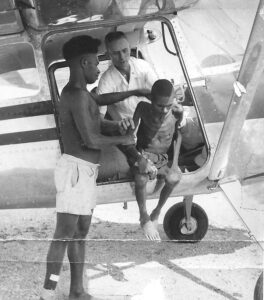
It was in talking with Sr. Marie Therese that I learned something new about Bishop Leo. Maybe “new” is not the correct word, for I am sure in my reading about him and my previous visit to Wewak, I had already “learned” about it; but nevertheless, I gained a new appreciation and a new insight into the person and spirituality of Bishop Leo by listening to Sister Marie Therese. Several times she repeated this same phrase: “He built everything with Mary.”
It wasn’t just a pious statement of a religious sister devoted to Mary, but a statement of fact. Humanly speaking, Bishop Arkfeld had a monumental task ahead of him when he arrived in Wewak. He was tasked with the responsibility of rebuilding an entire diocese after the Second World War. (Note: The previous bishop, Bishop Josef Loerks, SVD, was martyred by the Japanese aboard the Akikaze in 1943.)
How did the man do it? Well, the answer, I believe, lies in Sr. Marie Therese’s statement, “he built everything with Mary.”
The last time I heard her say this was when we were sitting at the airport that same afternoon waiting for our evening flight back to Vanimo. “He built everything with Mary.” I realized then that the immense work done by Bishop Leo was not just the initiative and result of a hardworking farm boy from Iowa or the gung-ho of a fearless and practical young priest—however much these human qualities of Bishop Leo certainly helped him in his missionary work—it was the Marian fervor of his heart and the Marian devotion of his life that made it all happen. “He built everything with Mary.”
Bishop Leo did not work alone. He worked with Mary. And that, I believe, was the key to his missionary success. His example serves as a reminder to all men and women consecrated to Mary.
Every endeavor—personal, spiritual, and apostolic—must always be carried out with Mary. It is a simple yet vital interior practice that can produce great fruits. According to St. Louis de Montfort, the greatest fruits it can produce is our personal growth in virtue in holiness. Since Mary is the “model of every virtue” and the “great and exclusive mold of God” doing all things with her will help us form Christ in us. But, as I have witnessed in Wewak, doing all things with Mary can also produce great apostolic fruits for the good of others.
Bishop Leo’s love and dependence on Mary bore both kinds of fruit. Urged on by the love of Christ and Mary, he transformed the lives of men, women and children in East Sepik. But his devotion also bore fruit in Bishop’s own life, especially through the virtue of simplicity and humility. I conclude by sharing one detail that gives witness to these two virtues.
Before he retired, the last thing that Bishop Leo built was the House of Prayer retreat Center on Mission Hill. In that retreat center he also had the workers build a little room for him. We visited this little room. It was roughly five meters long and four meters wide with a little bathroom attached. Bishop Leo’s intention was to spend the rest of his days after retirement in this little room until the day he died. He didn’t plan on just living there but also working there until he died. He wanted to be there so he could preach retreats, hear confessions and offer pastoral guidance.
What a way for Wewak’s beloved Bishop to spend his last days! What gave him this idea? What motivated him? I believe it was the simplicity and humility of a man whose heart had become Mary’s. Mary shaped his heart to be like hers, simple, humble, and never-tiring in the effort to bring people to Christ.
Of everything that Bishop Leo “built with Mary”, perhaps the most important of all was the place he had built in his heart for her. He made his heart all hers.
Seize the day and make it all hers, too!